How-to
How to charge a LiPo battery for an RC car
Updated November 1, 2026
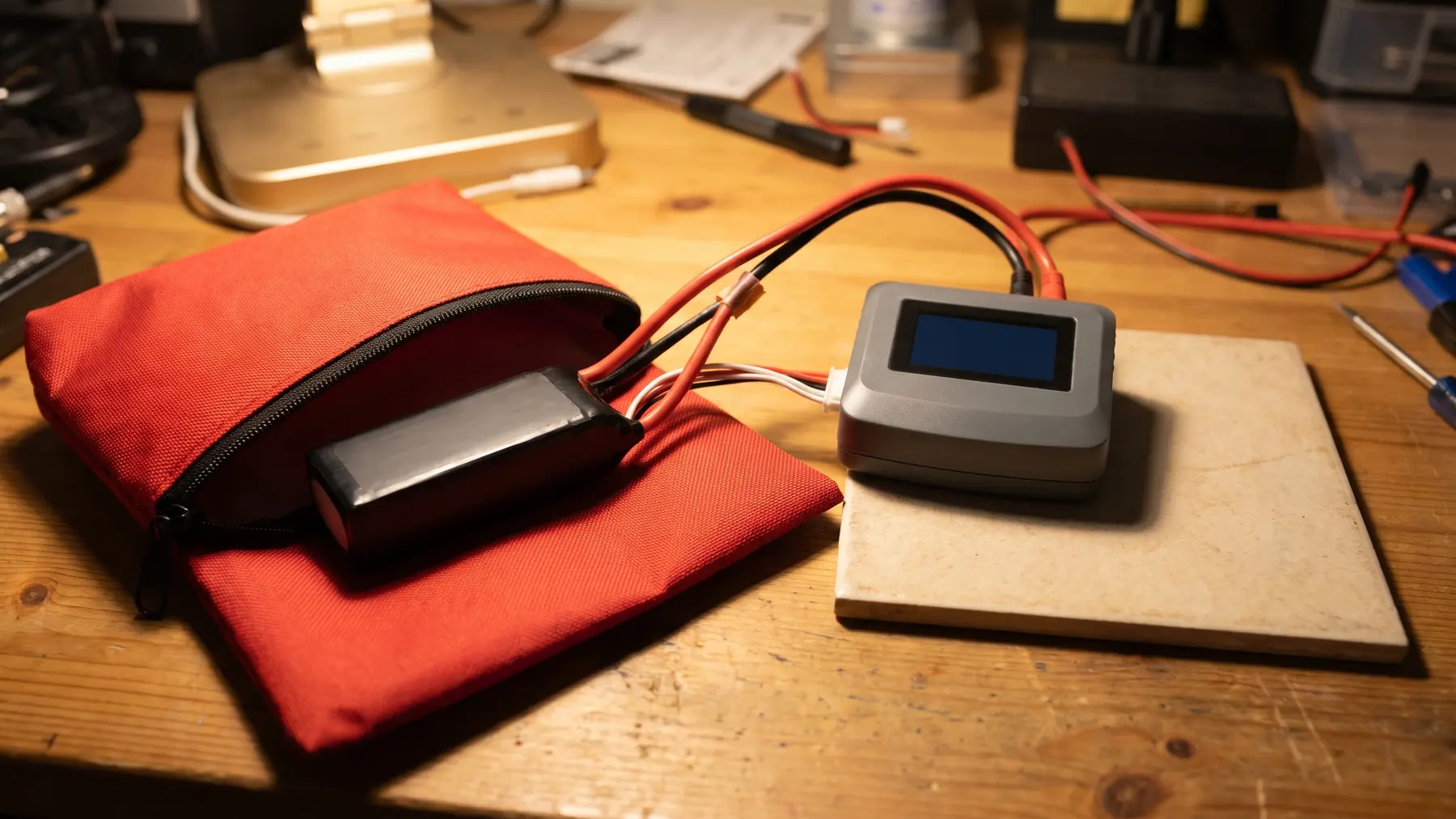
To charge a LiPo battery for an RC car, set a LiPo balance charger to the pack's cell count and a 1C rate, plug in both the main lead and the small balance lead, and stay in the room until the charger says it's done. 1C means a charge current in amps equal to the pack's capacity in amp-hours, so 5 A for a 5,000 mAh pack. Balance charging means the charger watches each cell separately and brings them all to the same voltage. A full cell reads 4.20 V.
Two rules matter most. Never use a NiMH or NiCad charger or mode on a LiPo, and never charge more than one pack at a time on one charger port. If you won't drive for more than seven days, use the charger's storage mode instead of leaving the pack full. That is the short version of how to charge an RC car battery safely.
The rest of this page walks through eight steps in the order you do them, from checking the pack to putting it away. After that come the topics that trip people up: how to store LiPo batteries and what storage voltage means, how to spot and dispose of a damaged pack, why makers forbid parallel charging, what to look for in a first charger, and how 2S vs 3S and C ratings apply to the car you own. If your car shipped with a USB charger and a small battery, follow that charger's manual. This guide is for hobby-grade LiPo packs and balance chargers.
This guide draws on maker manuals and owner reports. Always follow the manual for your own battery, charger and car when it differs from what we say here.
What you need
- A LiPo balance charger that supports your pack's cell count (2S, 3S or higher)
- The LiPo pack, with its label showing cell count and capacity in mAh
- A LiPo safety bag or fire-resistant battery container
- A nonflammable surface well clear of anything that burns
- The battery maker's manual, for any stated maximum charge rate
- A wall outlet for an AC charger, or a compatible power supply for a DC charger
- Charge and balance leads whose connectors match your pack
Step by step
- Step 1
Check the pack, leads and temperature before you plug in
Look the pack over in good light. The pouch should be flat and firm, the wrapping tight, the wires intact and the connector clean. If the pack is swollen, hot, leaking, punctured or crushed, or the wires or connector are damaged, stop here and go to the damaged-pack section below. Don't charge a damaged pack. Traxxas says not to use or charge a physically damaged pack.
Then check temperature. Traxxas gives a charging range of 32 to 110°F (0 to 43°C). A pack straight off a hard run can sit above that, so let it cool on the bench before it goes on the charger. On a Traxxas pack, skipping this means charging outside Traxxas's stated range. Check your own battery maker's range.
While the pack is in your hands, read the label and note three things: cell count (2S, 3S and so on), capacity in mAh, and any maximum charge rate the battery maker prints. You'll enter them in step four.
- Step 2
Set up a charging spot that can survive a bad day
Pick a nonflammable surface well away from carpet, paper, curtains and anything else that burns. Put the pack in a LiPo safety bag, a fire-resistant battery container or another nonflammable enclosure. This isn't just caution from forum veterans. The listings for ARRMA's Senton 223S and Typhon 223S both call for a charging bag along with the LiPo and charger.
Be realistic about what the bag does. Nobody seems to have measured whether any consumer bag or box fully contains a LiPo fire. We'd treat a bag as a way to reduce the damage, not as permission to walk away. Distance from flammable things and staying close matter just as much.
- Step 3
Set the charger to LiPo balance mode
Power up the charger and pick the LiPo program in balance mode. Balance mode reads each cell through the small multi-pin balance connector and adjusts the charge so the cells finish at the same voltage. Traxxas calls it the recommended everyday mode because it supports capacity, voltage and battery life. The reason it matters: a pack can look normal on average while one cell is overcharged.
Never charge a LiPo on a NiMH or NiCad charger or in a NiMH mode. The Traxxas manuals say so directly, and picking the wrong battery type is named as a common cause of charging mishaps. We'd skip any charger that can't balance-charge LiPos.
Traxxas also offers Fast and Storage modes. Fast mode doesn't balance the cells, so don't make it your habit. If you own a Traxxas iD battery and an iD charger, the charger recognizes the chemistry, cell count and capacity and defaults to balance charging. You should still read the display before you press start, because Traxxas says iD doesn't make a damaged or wrongly connected battery safe.
- Step 4
Enter the cell count, capacity and a 1C charge current
Match the charger to the label. A 2S pack has two cells (7.4 V nominal, 8.4 V full). A 3S pack has three (11.1 V nominal, 12.6 V full). Selecting the wrong cell count or the wrong current is one of the biggest setup mistakes, and it's why step one had you write the numbers down.
For current, 1C is the conservative default unless the battery maker says otherwise. A 5,000 mAh pack is 5 Ah, so 1C is 5 A, and the charge takes roughly an hour plus extra time for the final balancing phase. If the battery maker prints a higher maximum, that's the maker's call and you follow it. We couldn't find any universal recommendation above 1C, so don't assume a higher rate is safe because a forum thread says so.
- Step 5
Connect the main lead and the balance lead, then read the display
Plug the main lead into the charger output and the balance connector into the balance port. Without the balance connection the charger can't see individual cells, so you lose the whole point of balance mode. Before you press start, read what the charger shows: LiPo chemistry, the right cell count and the current you set. Many chargers also show pack voltage and each cell's voltage.
Look at the starting voltage too. One charger manual says cells below about 3.3 V need a reduced starting current until they recover, and over-discharging can damage cells and make later charging unsafe. If the charger flags a low cell or shows one cell far from the others, we'd treat that as a warning about the pack, not an obstacle to force past.
- Step 6
Stay with the pack while it charges
Don't leave a charging battery unattended. An hour is a long time to be in another room, so do something nearby and glance at the pack and display every few minutes. If the pack swells, gets hot or leaks, unplug it and move it outdoors, away from anything combustible. Do not keep charging it to see what happens.
Charge one pack at a time. If your truck uses two packs, such as the 6S trucks that take two 3S batteries, each pack gets its own charge cycle. The section on parallel charging explains why. The final stretch of a charge is slow, because the charger holds voltage at the top and finishes balancing. That's normal.
- Step 7
Confirm the pack is done by the charger, not the clock
The charger should end the charge on its own and show a completion message. On a cell display, each cell should read about 4.20 V. In balance mode the charger finishes after bringing the cells together, and one Spektrum manual describes balancing to within 0.03 V or closer before charging ends. If your display shows only total pack voltage, a full 2S reads 8.4 V and a full 3S reads 12.6 V.
The hour estimate is only an estimate. Don't judge completion by elapsed time alone. Wait for the charger's message and check the cell voltages if your charger shows them.
- Step 8
Unplug, then decide whether the pack gets driven or stored
Unplug the pack from the charger first, then unplug the charger from power. Put the pack straight back in its bag or container instead of leaving it lying on the bench.
Now decide. If you'll drive within a few days, leave it. Traxxas says to use Storage Charge mode when a pack won't be used for more than seven days. Better still, run storage mode instead of a full charge when you know the truck is parked for the week. The next section covers storage voltage and temperature.
How to store LiPo batteries between runs and over winter
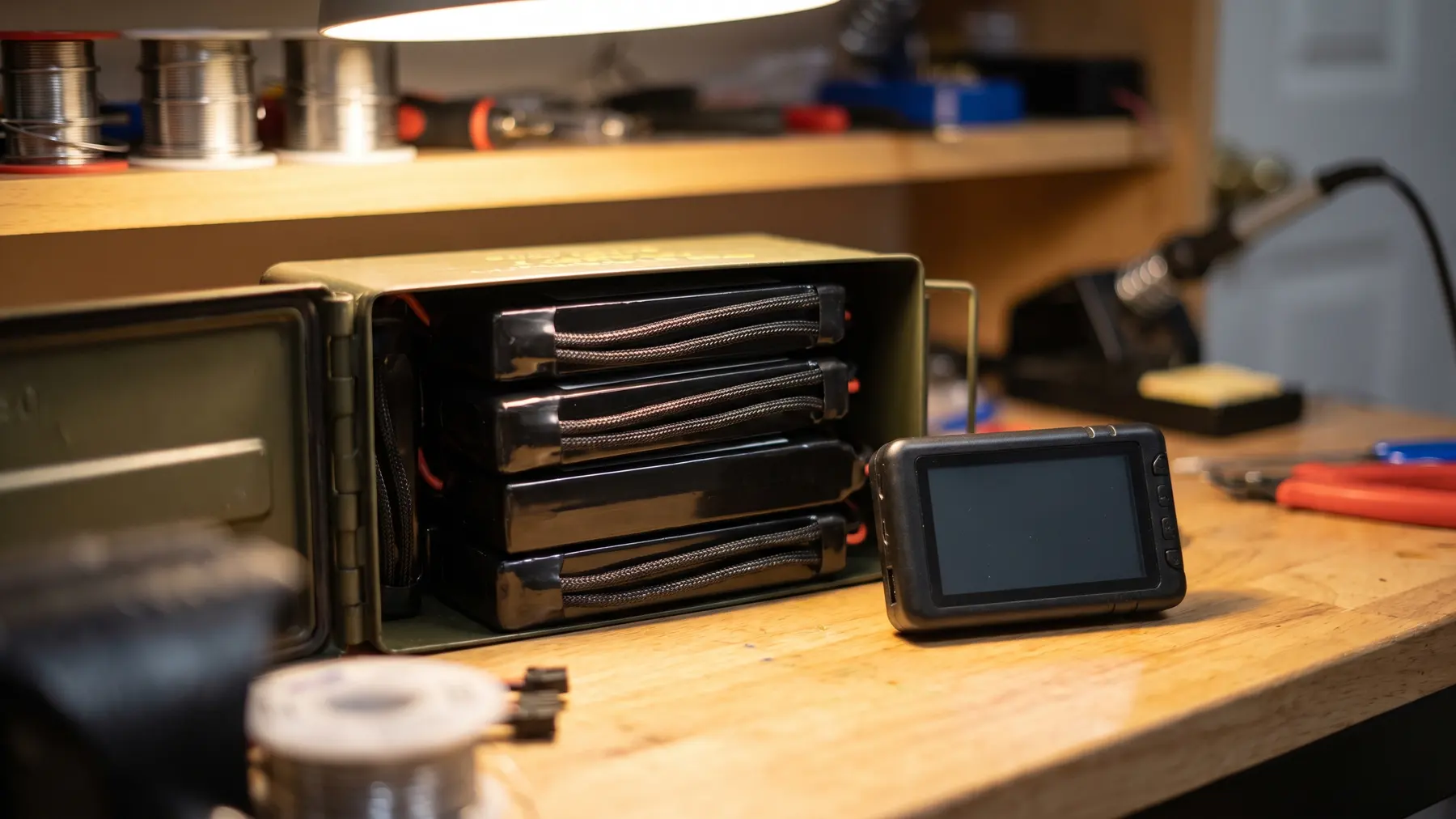
LiPo storage voltage is about 3.8 to 3.85 V per cell, roughly 50% charge. That works out to about 7.6 to 7.7 V for a 2S pack and 11.4 to 11.55 V for a 3S. Nominal voltage, about 3.7 V per cell, is the average label figure, not a storage target. Let the charger's storage mode get you there. For a pack you won't use for 30 days or more, Traxxas recommends 50 to 60% capacity.
Keep packs cool and dry. Spektrum and Traxxas both say storage should not exceed 140°F (60°C). Gens Ace gives a storage range of -10°C to 45°C and says long-term storage should be at 23 ± 5°C. We'd keep packs indoors at room temperature, not in a parked car or an unventilated shed.
Store them in the same LiPo bag or fire-resistant container you charge in, away from combustible materials, and look them over now and then for swelling or damage. A pack left full for months is the classic way to shorten its life, and it's the easiest mistake to avoid.
Spot a puffed or damaged pack and get rid of it
A puffed LiPo has a visibly swollen or ballooned pouch. Other warning signs are loose or separated wrapping, punctures, crushed cells, and damaged wires or connectors. Stop using, charging or transporting any pack that is swollen, hot, leaking, punctured or otherwise damaged. A swollen, split or torn pack should come out of service immediately.
Packs also wear out without any drama. One battery source says to retire a LiPo once it has lost 20% of its initial capacity. One RC maintenance source puts the average life at 150 to 250 charge cycles for packs that are charged at 1C and stored around 3.75 to 3.85 V per cell. Treat both as rough guides, not promises.
Never put a damaged pack in household trash or recycling. Isolate it outdoors away from combustible materials and call a household hazardous-waste facility, a battery recycler or a hobby shop for the procedure they require. Call2Recycle's steps are to gather the batteries, stay within its limit of 5 kg per battery, find a collection site and put them in the collection box. It doesn't mention a discharge step.
Traxxas gives a procedure for a pack being disposed of. Discharge it to 2.8 V per cell or less, submerge it completely in saturated salt water for 24 hours, then measure it. If it isn't at 0.0 V, submerge and retest until it is. Then recycle it, and the manual lists RBRC at 1-800-822-8831 for a nearby drop-off. Those steps are for a pack being retired. For a swollen or damaged pack, we'd call the hobby shop first.
Why makers forbid parallel charging
Parallel charging means plugging several packs into one charger port, usually through a parallel board, so they charge together. The Traxxas manuals say never to charge LiPo packs in series or parallel. Their reason is that the charger may recognize the cells incorrectly and apply an improper rate, which can cause overcharging, imbalance, damage or fire. The maker's rule is one pack at a time, and that's the rule to follow.
Forum users do it anyway, with conditions: the same cell count and nominal voltage, closely matched state of charge, capacity, chemistry and condition, polarity checked before plugging in, and packs and leads sitting on an insulated, nonconductive surface. We read that list as proof of how much can go wrong. One Reddit user reports that once the first pack is connected, the other charge leads become live, so an exposed male plug can short against a metal charger case or a carbon-fiber chassis. Reported failures include unequal voltages making one pack dump current into another, mismatched packs and overheating.
Our position is simple. Pay the time cost and charge packs one after another. If that gets tedious, a second charger is a better fix than a parallel board. For trucks that run two packs, like the 8S Traxxas X-Maxx, Traxxas names the EZ-Peak Live Dual 2973 charger. Read its manual for how it handles two packs before you assume anything.
What to look for in a first LiPo charger
Start with the non-negotiables: a balance port and a LiPo balance mode, selectable cell count covering your packs (2S and 3S at minimum), adjustable charge current with a 1C setting, and a storage mode. A storage-discharge function is useful too, for packs that have to come down from full. A clear display showing pack voltage, individual cell voltages, current, elapsed time and completion status makes steps five through seven easier. Over-voltage, over-current, short-circuit, reverse-polarity and temperature protection are all worth having.
Check the wattage. A 2S pack charged at 5 A needs about 42 W (8.4 V times 5 A), and a 3S needs about 63 W (12.6 V times 5 A), before charger inefficiency. A charger in the 50 to 100 W range is adequate for many 2S and 3S packs around 5,000 mAh, subject to the charger's actual output limits. An AC charger plugs into the wall and is simpler for a first setup. A DC charger needs a separate compatible power supply.
Skip any charger that only supports NiMH, and don't count on Fast modes, since Traxxas says its Fast mode doesn't balance the cells and may reduce runtime slightly. Traxxas iD chargers are the least fiddly if you own Traxxas iD batteries, because they pick the settings for you. Older non-iD Traxxas packs can still be charged by entering the battery type and charge rate manually.
If you haven't bought a car yet, a model that ships with its own battery and charger skips this decision. The ARRMA Granite Grom includes a 2S LiPo and charger, and our best RC cars for beginners list is a good place to look at others. The Losi Mini-T 2.0 includes its charger and needs a USB power adapter rated at 18W or more.
2S vs 3S LiPo and C ratings: match the battery to your car
The S number is the cell count. 2S is 7.4 V nominal and 3S is 11.1 V. More cells mean more voltage and, per the makers, more speed. The ARRMA Granite 223S takes a 2S or 3S hardcase LiPo, and ARRMA claims 50+ mph on 3S. The ARRMA Vorteks 223S is claimed at 35+ mph on 2S and 50+ mph on 3S. ARRMA claims the same numbers for the Typhon 223S. One reviewer measured just over 30 mph. Our guide to making an RC car faster covers the speed side of that choice.
The right LiPo battery for an RC car is the one your electronics accept, so check the manual before you buy. The Traxxas Slash 4X4 VXL uses a VXL-3s system that supports 2S to 3S LiPo, and Traxxas sells neither battery nor charger in the box. The Traxxas Maxx takes 3S or 4S, and Traxxas claims 55+ mph on 4S stock and 60+ mph with optional gearing. The ARRMA Kraton 6S EXB accepts 2x2S, 1x4S, 2x3S or 1x6S hardcase packs, up to 22.2 V on 6S, and needs a compatible IC5 charger. The ARRMA Felony 6S wants one 6S or two 3S packs with EC5 or IC5 connectors, and the Traxxas X-Maxx wants two 4S packs with Traxxas High Current Connectors. If you want these speeds, our fastest RC cars ranking shows what's out there.
Then check fit and connector. Typhon packs must fit a 147 x 51 x 48 mm battery space. Hardcase packs wrap the cells in a rigid shell that protects against abrasion, punctures and impacts, which suits a truck that takes stones and crashes. Softcase packs use flexible film and are lighter, but the cells are more exposed to puncture and crushing.
The C rating on a pack is a different number from the 1C charge rate. It describes the maker's claimed maximum continuous discharge relative to capacity. On a 5,000 mAh pack, 30C is 150 A and 50C is 250 A. These are claims, not measured output, so don't buy on C rating alone.
An ESC (the electronic speed controller that powers the motor) can have a low-voltage cutoff that cuts power or stops the truck when pack voltage drops to a preset level. If your truck slows suddenly or cuts out, stop driving. Discharging below 3.0 V per cell under load can deteriorate performance. A cutoff watches the whole pack, so it can miss one weak cell, and there's no single cutoff value that fits every RC LiPo.
Cars this guide applies to
 ARRMA Granite 223S review
$339.99, 2S or 3S LiPo
 Traxxas Slash 4X4 VXL review
$429.99, 2S to 3S LiPo, or NiMH
 ARRMA Typhon 223S review
$339.99, 2S or 3S LiPo
 Traxxas X-Maxx review
$1199.95, 8S LiPo (two 4S packs)
 ARRMA Kraton 6S EXB review
$829.99, 4S or 6S LiPo
 Traxxas Maxx review
$599.99, 3S to 4S LiPo
Common questions
What voltage is a fully charged LiPo cell, what is nominal voltage, and what is storage voltage?
A fully charged LiPo cell is 4.20 V. Nominal voltage is about 3.7 V per cell, an average label figure. Storage voltage is about 3.8 to 3.85 V per cell, roughly 50% charge. That means a 2S is 8.4 V full, 7.4 V nominal and 7.6 to 7.7 V in storage, and a 3S is 12.6 V, 11.1 V and 11.4 to 11.55 V.
What charge rate should you use for an RC LiPo, and what does 1C mean?
Use 1C unless the battery maker specifies otherwise. 1C is a charge current in amps equal to the pack's capacity in amp-hours, so a 5,000 mAh pack charges at 5 A in roughly an hour plus balancing time. If the maker prints a higher maximum, follow that instead of guessing.
What is balance charging and why does it matter?
Balance charging monitors each cell through the balance connector and adjusts the charge so all cells reach the same voltage. It matters because one cell can be overcharged even when the pack's average voltage looks normal. Traxxas recommends it as the everyday mode.
How can you tell when a LiPo is fully charged?
The charger ends the charge automatically and shows a completion message. Each cell should read about 4.20 V. One Spektrum manual describes balancing cells to within 0.03 V or closer before charging ends. Don't go by elapsed time alone.
How should you store LiPo batteries between runs and long term, including temperature and fire-safe containers?
Use Storage Charge mode if the pack won't be used for more than seven days, and aim for 50 to 60% capacity for 30 days or more, per Traxxas. Keep packs cool and dry, never above 140°F (60°C) per Spektrum and Traxxas. Gens Ace gives 23 ± 5°C for long-term storage. Keep them in a LiPo safety bag or fire-resistant container away from combustibles.
How do you spot a puffed or damaged LiPo, and how do you dispose of one safely?
Look for a swollen pouch, loose or separated wrapping, punctures, crushed cells, or damaged wires and connectors. Stop using and charging it, and keep it outdoors away from combustibles. Never put it in household trash or recycling, and call a hazardous-waste facility, battery recycler or hobby shop. Traxxas's disposal procedure is to discharge to 2.8 V per cell or less, soak in saturated salt water for 24 hours, check for 0.0 V, then recycle.