Drift car, 1/10 scale
Redcat RDS review
A capable RWD drift car for track drivers, but budget for a battery, charger and a setup session.
$399.99
See it at HobbyQuartersBattery and charger cost extra.
We haven't driven this car. This review is our subjective opinion, based on the sources listed below.
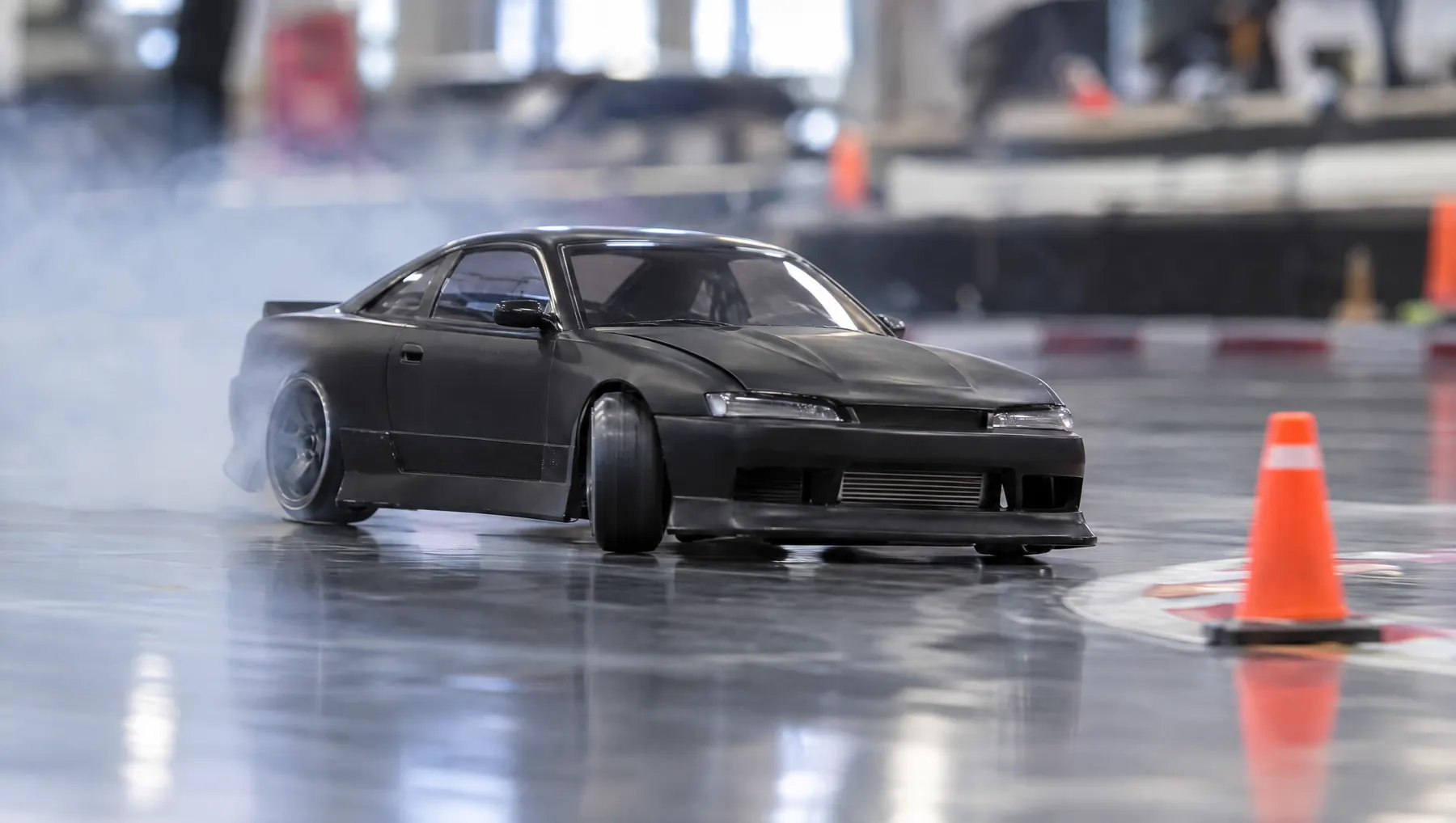
The Redcat RDS is a 1/10 rear-wheel-drive brushless drift car at $399.99, and we think it's a solid pick if you have a real drift surface like carpet, p-tile or polished concrete. It comes with a drift gyro, a brushless speed controller, a steering servo and a radio, and reviewers say it drifts well once it's dialed in.
The catch is the work and the extra spending. The battery and charger aren't included, and owners report tight suspension joints and a plastic servo horn that can strip. Owners also report too much factory camber and front toe. If you want something to slide around a driveway, this isn't it.
Out of the box it drifts, but plan a setup session
The RDS has a 540 3300KV brushless motor and a drift gyro, a small sensor that counter-steers for you when the rear end slides. One reviewer found it comfortable and usable in stock form, with no major ill-handling during a track test. A reviewer also said it worked well on a glossy track after adjusting rear rake, camber and spring settings. Steering is described as very direct and free of slop.
Owners are less relaxed about the factory setup. Owners report too much factory camber (wheel lean) and front toe (the angle the wheels point), and one found the car difficult to drive until it was corrected. Others say the suspension ball cups are so tight that the arms bind, and one owner found three of four tires loose on their rims and fixed them with O-rings. Reviewers also say steering throw is limited because the knuckle stops keep the leading wheel from reaching the angle you want.
One independent review calls the RDS a good but not exceptional starting platform with upgrade potential. We think that's fair. Owners say it drifts well after alignment, binding and gyro endpoints are sorted, so treat the first evening as part of the purchase.
Replace the plastic servo horn first
The clearest weak point is the stock plastic servo horn, the arm that connects the steering servo to the steering. Owners and reviewers say a hit to a front wheel loads the steering through the servo spline and can strip the horn. The usual fix is Redcat's aluminum horn, part RER19685. It's the first upgrade we'd make, before you ever hit a wall.
Next, free up the suspension. Owners suggest polishing or wearing in the ball studs, replacing the cups, or fitting Yokomo or MST parts. One owner found oversized shims at the arm hinge pins, another saw spacer lengths that varied enough to cause arm wobble, and one builder swapped all four shocks for MST units because the stock ones weren't smooth. One owner reported a failed receiver, but that's a single report.
Parts support looks decent but not deep. Redcat sells chassis parts directly, and owners say a range of Yokomo parts fit, including ball cups, arms, hubs and differential pieces. One owner says Redcat doesn't seem to back aftermarket products broadly and doubts local shops will help much.
What $399.99 really buys
This is not a drive-away package. You need a 2S LiPo (a two-cell lithium battery), a compatible LiPo charger, and transmitter batteries if your package lacks them. Basic drift tools and spare tires are smart additions. The chassis takes competition-style 2S shorty packs, LCG shorty packs (low center of gravity, to keep weight down low) and standard 2S sticks, so you can shift weight balance by choosing a battery.
One owner recommends a hard-case 5,400 mAh LiPo, saying it fits the stock battery location better. Another made a 3,200 mAh soft-case pack work with Velcro cable ties but considered it a poorer fit. A reviewer says the stock system doesn't call for an especially expensive or high-output battery. We couldn't find a recommended connector, so check what plug your battery and charger use before you order.
Surface matters as much as the battery. The RDS is reported to work especially well on carpet, p-tile and polished concrete. On rough asphalt or unpolished concrete you'll get less out of it, and tires matter. One owner suggests changing tires for your surface and practicing before modifying much.
Against the MST RMX 2.5, the Yokomo RDX and a cheap tryout
The closest rival on our site is the MST RMX 2.5, also a 1/10 rear-wheel-drive drift car at $399.99. We score it 6.4 to the RDS's 6.0, so it has a slight edge, though that's a judgment call. Owners report fitting MST ball cups, studs and shocks to the RDS, but that's about replacement parts, not a comparison of the two cars as complete packages.
Outside our lineup, one owner says the Yokomo RDX drives significantly better out of the box than the RDS, especially in steering, and picked it for that reason. Others still find the RDS attractive for its price, carbon-fiber construction, aluminum shocks and magnetic body mounts. If you like to tinker and you're on a budget, we'd buy the RDS. If you want the best stock driving, the RDX reports are worth a look.
If you aren't sure you'll stick with drifting, the Turbo Racing C64 at $75.99 is a far cheaper way to try it, though it's a tiny 1:76 car and scores 5.1 on our site. It won't replace a track car, but it can tell you whether you'll enjoy the hobby before you spend $400 plus a battery and charger.
What owners and reviewers like
- The drift gyro is included in the box.
- Reported to work especially well on carpet, p-tile and polished concrete.
- Direct steering with no slop, according to one reviewer.
- Several 2S battery formats let you tune weight balance.
- Yokomo and MST parts reportedly fit for upgrades.
What to watch out for
- No battery or charger in the box.
- The plastic servo horn can strip after a front-wheel impact.
- Tight ball cups can bind the suspension, owners report excess camber and toe, and one had to fix loose tires.
- Steering throw is limited by the stock knuckle stops.
- Much less capable on rough asphalt and unpolished concrete.
Buy it for
Hobbyists with access to a smooth drift surface who don't mind tuning and upgrading a car to get it running right.
Skip it if
You want a ready-to-run casual car for your driveway or rough pavement.
Specs
- Top speed
- Drift cars are built for control, and we couldn't confirm a maker figure
- Scale
- 1/10
- Drive
- RWD
- Motor
- 540 3300KV brushless
- Power
- 2S LiPo
- Water
- Not confirmed by the maker
- You'll need
- A 2S LiPo in shorty or stick format, a LiPo charger, and transmitter batteries if not included.
Common questions
Does the Redcat RDS come with a battery and charger?
No. It's ready to run, but you need to supply a 2S LiPo battery and a compatible LiPo charger. You may also need batteries for the transmitter if your package doesn't include them.
What battery does the Redcat RDS use?
A 2S LiPo. It accepts competition shorty packs, LCG shorty packs and standard 2S sticks. One owner recommends a hard-case 5,400 mAh pack for a better fit in the stock battery location.
Where does the Redcat RDS drift best?
Reviewers report it works especially well on carpet, p-tile and polished concrete. It's less capable on rough asphalt and unpolished concrete.
What should I upgrade first on the Redcat RDS?
Owners most often recommend the aluminum servo horn, Redcat part RER19685, because the stock plastic one can strip after a front-wheel impact. After that, they suggest freeing up the tight ball cups and correcting camber, toe and gyro settings.
Where it ranks
Guides for owners
Similar cars
- MST RMX 2.5$399.99
- Turbo Racing C64$75.99
- Yokomo Rookie Drift$349.99
Sources
Where this review's facts and owner reports came from.